
Bring us the problem. We'll help build what solves it.
Workbees works with businesses to turn real operational requirements into focused digital products and systems.
From an early idea to a working product, we shape the technology around how the business actually needs to operate.
- 01Context
What isn't working?
A process is slow, manual, disconnected, or difficult to manage.
- 02Alignment
What needs to change?
We clarify the users, workflow, and outcome that matters.
- 03Outcome
What should we build?
We shape a focused product or system around the real requirement.
Technology shaped around the requirement.
Some businesses need a customer-facing product. Others need an internal operational system. Often, the real solution includes both.
- 01Capability
Digital Products
Customer-facing web and mobile experiences built around a clear business use case.
Typical realizations
- Mobile applications
- Web platforms
- Customer portals
WB / 01 - 02Capability
Operational Systems
Technology that helps teams manage, coordinate and understand day-to-day operations.
Typical realizations
- Internal dashboards
- Workflow systems
- Operational tools
WB / 02 - 03Capability
Connected Experience
Products that connect customers, teams, partners or service providers through one coordinated experience.
Typical realizations
- Booking systems
- Marketplace workflows
- Multi-role platforms
WB / 03
You don't need a finished specification.
A useful product usually starts with a clearer understanding of the problem — who is using it, what needs to happen and where the current process creates friction.
- 01
Current reality
Understand how the work happens today.
We look at the people, process and systems already in place before deciding what technology should change.
- 02
What needs to change
Find where technology can remove friction.
We identify the gaps, repetitive work and missing visibility that are worth solving.
- 03
Product direction
Shape the system around the requirement.
We turn the clearest opportunity into a focused product, workflow or digital system.
From requirement to working product.
We keep the process focused: understand what matters, shape the right direction, build around the requirement, and continue improving as the product is used.
- 01Phase
Understand
Clarify the problem, users, workflow and intended outcome.
01 / 04 - 02Phase
Shape
Turn the requirement into a focused product direction and usable experience.
02 / 04 - 03Phase
Build
Design and develop the product around the agreed scope and real operational needs.
03 / 04 - 04Phase
Evolve
Support, improve and extend the product as requirements change.
04 / 04
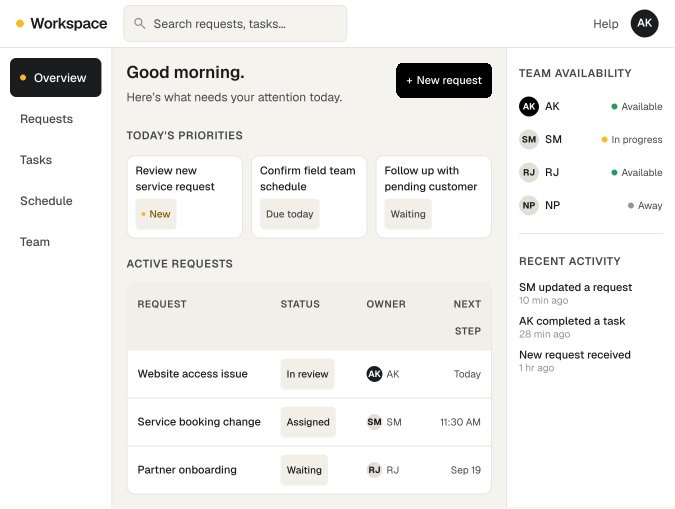
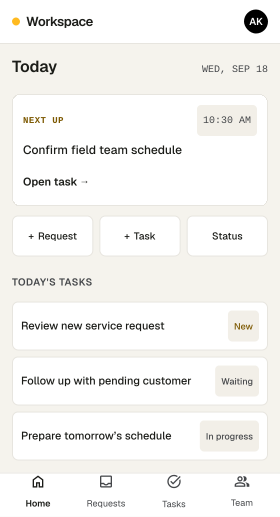
Designed for the people who actually use it.
Good technology is not only about what the system can do. It also needs to make sense to the people using it every day.
Clear experiences
Intuitive interfaces that teams and customers can understand and adopt without unnecessary friction.
Useful workflows
Focused interactions designed around the work people actually need to complete.
Responsive products
Reliable experiences designed to work across desktop, tablet and mobile contexts.
A product doesn’t stop when it goes live.
Requirements change, customers respond, operations grow and better ideas appear after real usage begins.
- 01
Support
Keep the product dependable after launch and ready for the work it needs to support.
Reliability - 02
Improve
Refine the experience using what real customers, teams and operations reveal over time.
Continuous improvement - 03
Extend
Add capabilities as the business grows and new requirements become clear.
Capability growth
We build our own products too.
Workbees approaches external projects with the same product mindset used to build its own technology — focusing on the problem, the experience and what needs to work in the real world.
- Mindset
Product thinking
We approach software as a product, not simply a list of requested features.
- Grounded
Real requirements
The product and system are shaped around how the business and its users actually operate.
- Continuity
Built to evolve
The relationship can continue beyond the initial build as usage reveals new requirements.
The same company building three different products.
Our own products give us direct experience shaping technology across mobility, consumer services and business growth.
- Mobility01
Navigster
Connected transport visibility and operational tools for better-managed journeys.
Explore product - Everyday services02
Balancers
A consumer platform being built around discovering, booking and managing everyday services.
Explore product - Business growth03
Runer
A focused application designed around business reach, marketing activity and growth.
Explore product
Tell us what needs to work better.
Bring us the requirement, challenge or product idea. We’ll start by understanding the problem.